

Most IVF clinic owners think digital marketing means running ads and getting leads.
That thinking is the biggest mistake.
In reality, IVF marketing is not about “leads”. It is about trust, patience, and long decision cycles. Couples do not decide in one click. They research, compare, doubt, and then come.
So if your system is not built properly, even expensive marketing will fail.
What is IVF Digital Marketing in 2026
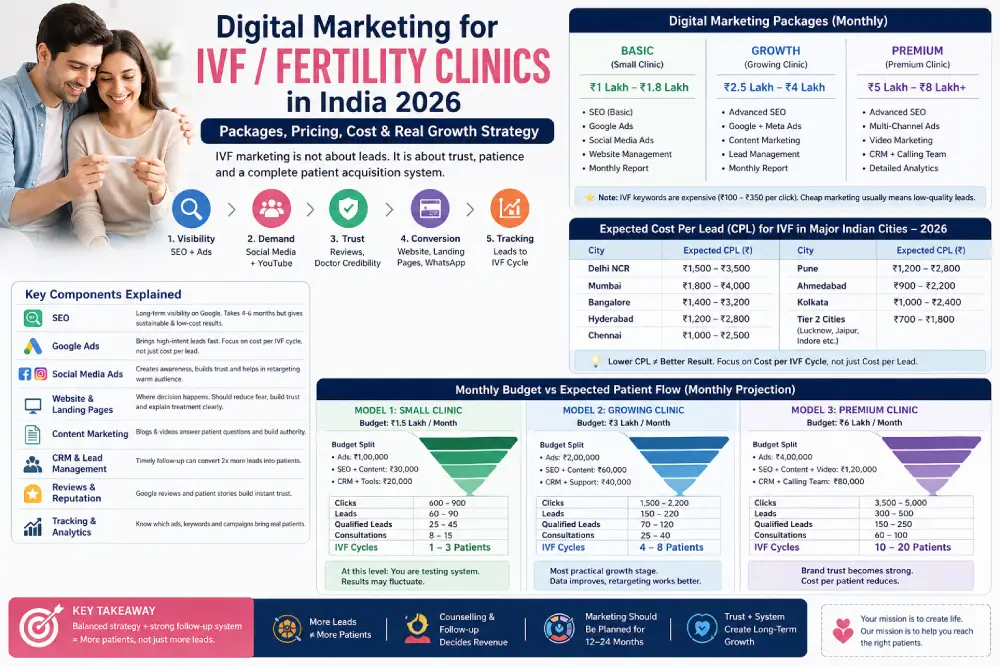
Digital marketing for IVF clinics is a complete patient acquisition system, not just ads.
It has 5 real parts:
- Search visibility (Google SEO + Ads)
- Demand creation (Social media, YouTube)
- Trust building (reviews, doctor credibility)
- Conversion system (website + landing pages + WhatsApp)
- Tracking system (leads → consultation → IVF cycle)
If even one part is weak, results break.
Real Pricing of Digital Marketing for IVF Centres in India (2026)
Let’s talk honestly, not agency packages.
Monthly Cost Range (India Reality)
- Small clinic: ₹1 lakh – ₹1.8 lakh
- Growing clinic: ₹2.5 lakh – ₹4 lakh
- Premium clinic: ₹5 lakh – ₹8 lakh+
Channel-wise Cost Breakdown
- SEO: ₹40,000 – ₹1,20,000/month
- Google Ads: ₹60,000 – ₹3,00,000+ ad spend
- Meta Ads: ₹40,000 – ₹1,50,000+
- Content + creatives: ₹20,000 – ₹60,000
- Agency/management: ₹30,000 – ₹1,50,000
👉 Important: IVF keywords are expensive (₹100–₹350 per click), so cheap marketing usually means low-quality leads.
Each Component Explained (For Real Business Growth)
1. SEO (Search Engine Optimization)
This is long-term game.
When someone searches:
“IVF clinic near me” → your clinic should appear.
Reality insight:
SEO takes 4–6 months minimum. But after that, cost per patient becomes cheaper than ads.
Mistake clinics do:
Stop SEO after 3 months → no results → blame marketing.
2. Google Ads (High Intent Leads)
This is fastest way to get patients.
But truth is:
- 100 leads ≠ 100 patients
- Only ~10–15% convert into IVF cycles
So you must calculate cost per cycle, not cost per lead.
Strong POV:
If your counselling is weak, Google Ads will only burn money.
3. Social Media Ads (Meta / Instagram)
This is not for direct IVF conversion.
It works for:
- Awareness
- Retargeting
- Emotional connection
Reality:
Cold audience rarely books IVF directly from Instagram.
4. Website & Landing Pages
Most clinics ignore this.
But this is where decision happens.
Your website should:
- Reduce fear
- Explain treatment clearly
- Show real doctor
- Show real cases (ethically)
Truth:
Bad website = good marketing wasted.
5. Content Marketing (Blogs + Videos)
IVF patients search questions like:
- “IVF success rate age 35”
- “IVF cost in Delhi”
- “Is IVF painful?”
If your clinic answers these, you win trust.
68% patients trust clinics more when they provide educational content.
6. Video & Trust Assets
This is underrated.
You need:
- Doctor introduction
- Patient testimonials
- Lab walkthrough
Without face + human connection → conversion drops.
7. CRM & Lead Management
Most clinics fail here.
Leads come → no follow-up → lost.
Basic CRM cost: ₹3k – ₹20k/month
Reality insight:
Marketing problem is often a follow-up problem.
8. Reviews & Reputation Management
Before visiting, patients check:
- Google reviews
- Ratings
- Patient stories
One negative review can reduce trust instantly.
9. Call Tracking & Data
You should know:
- Which ad gave patient
- Which keyword worked
- Which campaign failed
Otherwise, you are guessing.
Real Growth Strategy (Not Theory)
What Actually Works in IVF
- Ads for immediate flow
- SEO for long-term stability
- Content for trust
- CRM for conversion
👉 This is called hybrid model (most practical)
Clinics using only ads stay dependent forever.
Clinics using only SEO struggle early.
Balanced system wins.
Brutal Truth About IVF Marketing
- Cheap leads are usually useless
- More leads ≠ more patients
- Doctor trust matters more than ads
- Follow-up system decides revenue
- Marketing should be planned for 12–24 months, not 30 days
Conclusion (Student POV)
If I explain simply:
Digital marketing for IVF is not “expense”.
It is a system of trust + visibility + conversion.
Most clinics fail because:
- They focus only on leads
- They ignore patient psychology
- They don’t track real ROI
The clinics that grow are not doing more ads.
They are doing better structure.
Expected Cost Per Lead (CPL) for IVF Clinics in Major Indian Cities (2026)
Before numbers, one thing should be clear:
👉 IVF CPL is not fixed.
It depends on:
- Competition in that city
- Doctor reputation
- Landing page quality
- Counselling system
Still, we can estimate realistic ranges based on CPC + conversion behaviour.
For example, in Delhi IVF ads:
- CPC: ₹80 – ₹350+
- Conversion rate: ~8–12%
- Resulting CPL: ₹1,200 – ₹3,500 per qualified lead
City-wise Expected IVF Lead Cost (India – 2026 Reality)
| City | Expected CPL (₹) | Market Reality |
| Delhi NCR | ₹1,500 – ₹3,500 | Highly competitive, high intent traffic |
| Mumbai | ₹1,800 – ₹4,000 | Premium audience, expensive clicks |
| Bangalore | ₹1,400 – ₹3,200 | Tech audience, research-heavy users |
| Hyderabad | ₹1,200 – ₹2,800 | Balanced cost + decent intent |
| Chennai | ₹1,000 – ₹2,500 | Lower CPC, strong medical trust factor |
| Pune | ₹1,200 – ₹2,800 | Mid competition |
| Ahmedabad | ₹900 – ₹2,200 | Lower competition |
| Tier 2 Cities (Lucknow, Jaipur, Indore etc.) | ₹700 – ₹1,800 | Cheap but mixed quality leads |
Strong Ground Reality (Very Important Insight)
This is where most people misunderstand marketing:
👉 Lower CPL ≠ better result
Example:
- Delhi lead = ₹2,500 → higher intent
- Tier 2 lead = ₹900 → more confusion, low conversion
So actual metric should be:
👉 Cost per IVF cycle, not cost per lead
From real funnel data:
- 100 leads → 30–40 qualified
- 30–40 → 5–8 consultations
- 5–8 → 1–2 IVF cycles
City Economics vs Patient Value (Important Connection)
Why CPL differs by city?
Because IVF treatment cost also differs:
- Metro cities cost higher by ₹50,000–₹1,00,000 per cycle compared to smaller cities
👉 That means clinics in metro cities can afford higher CPL.
Final Practical Understanding
If I simplify:
- Big city = expensive leads, but serious patients
- Small city = cheap leads, but more filtering needed
So the smartest approach is:
👉 Not “cheap marketing”
👉 But “right patient acquisition system”
One Honest Line (Experience Insight)
If someone promises:
- ₹300 IVF leads
- Or 100 leads in ₹10,000
Then most likely:
👉 Those are not real IVF patients
Monthly Budget vs Expected Patient Flow (IVF Clinics – India 2026)
First, understand one thing clearly:
👉 IVF marketing is a funnel, not a shortcut
Flow looks like this:
Budget → Clicks → Leads → Qualified Leads → Consultations → IVF Cycles
If you don’t track each step, you will always feel “marketing is not working”.
Base Assumptions (Realistic Market Numbers)
These are average working benchmarks:
- Cost per click (CPC): ₹100 – ₹300
- Landing page conversion: 8% – 12%
- Lead to qualified: 40% – 60%
- Qualified to consultation: 20% – 30%
- Consultation to IVF cycle: 20% – 30%
👉 This means:
100 leads ≈ 1–2 IVF cycles
Model 1: Small Clinic (₹1.5 Lakh / Month Budget)
Budget Split
- Ads (Google + Meta): ₹1,00,000
- SEO + Content: ₹30,000
- CRM + tools: ₹20,000
Expected Funnel
- Clicks: ~600 – 900
- Leads: 60 – 90
- Qualified leads: 25 – 45
- Consultations: 8 – 15
- IVF cycles: 1 – 3 patients/month
Reality Insight
At this level:
- You are testing system
- Results may fluctuate
- Counselling quality matters a lot
Model 2: Growing Clinic (₹3 Lakh / Month Budget)
Budget Split
- Ads: ₹2,00,000
- SEO + Content: ₹60,000
- CRM + team support: ₹40,000
Expected Funnel
- Clicks: ~1,500 – 2,200
- Leads: 150 – 220
- Qualified leads: 70 – 120
- Consultations: 25 – 40
- IVF cycles: 4 – 8 patients/month
Reality Insight
This is the most practical growth stage.
- Data starts improving
- Retargeting works better
- Brand recall begins
Model 3: Premium Clinic (₹6 Lakh / Month Budget)
Budget Split
- Ads: ₹4,00,000
- SEO + Content + Video: ₹1,20,000
- CRM + calling team: ₹80,000
Expected Funnel
- Clicks: ~3,500 – 5,000
- Leads: 300 – 500
- Qualified leads: 150 – 250
- Consultations: 60 – 100
- IVF cycles: 10 – 20 patients/month
Reality Insight
At this level:
- Brand trust becomes strong
- Repeat referrals increase
- Cost per patient reduces
Important: Cost Per IVF Patient (Actual Metric)
Let’s calculate simply:
Example (₹3 Lakh Budget)
- IVF patients: 5 (average)
👉 Cost per patient = ₹60,000
Now compare with IVF package value:
- IVF treatment value: ₹1.5L – ₹2.5L
👉 Still profitable if system is correct
Where Most Clinics Go Wrong
1. They track only leads
But leads don’t give revenue.
2. No follow-up system
Leads go cold in 24–48 hours.
3. Weak counselling
Patients need emotional clarity, not sales pitch.
4. No retargeting
Patients don’t decide in one visit.
Strong Ground Truth
👉 Marketing does not fail
👉 System fails
Because:
- Ads bring attention
- Website builds interest
- Counselling closes decision
If any one is weak → patient lost
Final Student POV (Simple Understanding)
If I explain in one line:
👉 ₹1–2 lakh budget = survival stage
👉 ₹3–4 lakh budget = growth stage
👉 ₹5 lakh+ = brand building stage
But:
- Budget alone does not matter
- Structure matters more
One Honest Insight (Experience Based)
Even with same budget:
- Clinic A gets 2 patients
- Clinic B gets 8 patients
Reason:
👉 Not marketing
👉 But system + trust + follow-up
FAQ’s
1. What is minimum budget to start IVF digital marketing?
At least ₹1 lakh/month is needed for serious results. Anything below this gives unstable output.
2. Which is better: SEO or Google Ads?
Both are needed. Ads give quick leads, SEO gives long-term growth.
3. Why IVF leads are expensive?
Because treatment value is high and competition is strong. Also patient decision takes time.
4. How long does it take to see results?
Ads: 1–2 weeks
SEO: 4–6 months
Full system: 6–12 months
5. Why leads are not converting into patients?
Main reasons:
- Poor counselling
- Slow follow-up
- Lack of trust
- Wrong targeting