

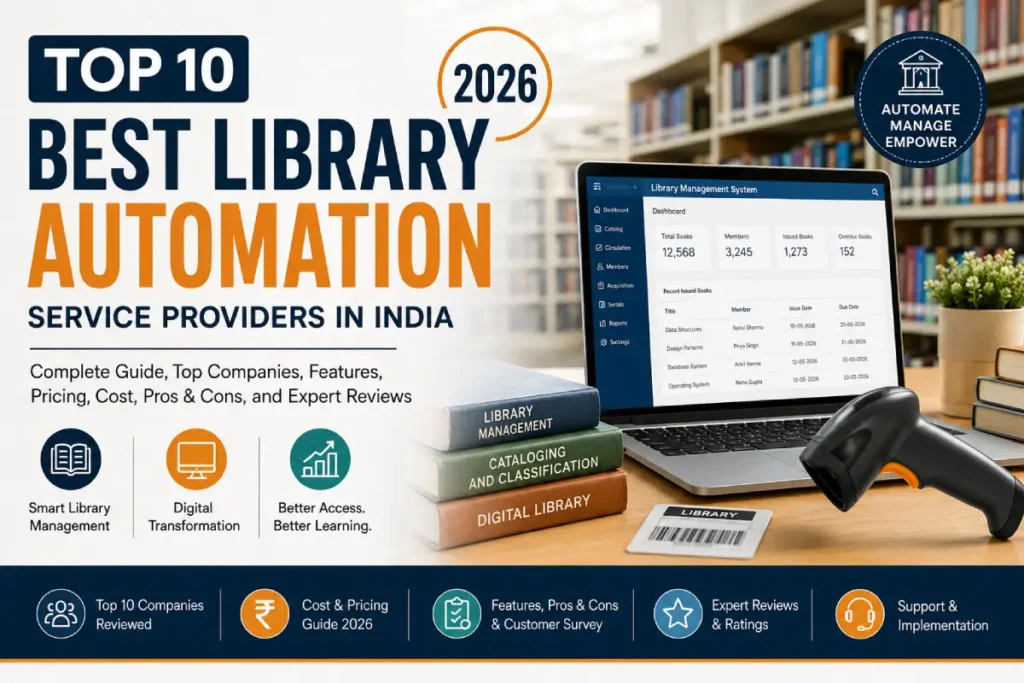
Updated for 2026 | Research-led comparison for schools, colleges, universities, public libraries and special libraries
Library automation is no longer only about replacing handwritten issue registers with a computer. In 2026, a good library system must connect cataloguing, circulation, member records, online search, digital resources, reporting, RFID and remote access. The real purpose is not to make a library “digital” for appearance. The purpose is to reduce repetitive work and make information easier to find, manage and use.
India has a large and diverse library environment. A small school library may need only book entry, barcode-based issue and return, and basic reports. A university library may need MARC21 cataloguing, authority control, serials management, KOHA, institutional repositories, RFID, discovery tools and integration with other academic systems. Because these requirements are different, there is no single library automation provider that is best for every institution.
This article takes a practical view. The ranking is based on publicly visible service scope, library-domain focus, implementation capability, support information, technology coverage, transparency and suitability for Indian institutions. It is not an official government ranking, and it should not be treated as a certification of service quality.
Our main finding is simple:
The software is only one part of library automation. Data quality, migration, staff training, support and long-term maintenance usually decide whether a project succeeds.
For this reason, a library should not select a provider only because the website shows many features. Before signing a contract, ask for a live demonstration using your own workflow, sample catalogue records, expected number of users and existing library data.
What Is Library Automation
Library automation is the use of software, computers, databases, barcode systems, RFID technology and digital tools to perform library work with greater speed, accuracy and consistency.
Traditionally, libraries used accession registers, catalogue cards, issue registers, member files and manual stock verification. These methods can work in a small collection, but they become difficult to manage when the number of books, users, transactions and digital resources increases.
An automated library system stores information in a central database. Librarians can add book records, manage members, issue and return books, calculate overdue periods, generate reports and allow users to search the catalogue online.
A modern library automation system may include:
- Acquisition and purchase management
- Cataloguing and classification
- Barcode or RFID-based circulation
- Member management
- OPAC or Web OPAC
- Serials and journal management
- Fine and overdue management
- Inventory and stock verification
- Reports and analytics
- Digital-library or repository integration
- Email or SMS notifications
- Remote access and cloud hosting
Library automation should not be confused with only creating an Excel sheet. A spreadsheet can store a list of books, but it does not normally provide a complete workflow for circulation, catalogue searching, member permissions, overdue control, reports and standards-based bibliographic management.
Modern integrated library systems can manage cataloguing, circulation, acquisitions, serials, user accounts, reporting and discovery through connected workflows.
The real value of automation
The strongest benefit is not simply saving time. Automation creates a reliable connection between the physical collection, library records and user access.
For example, when a book is issued through a barcode or RFID system, its status can change immediately. The librarian can see who borrowed it and when it is due. A student can check availability through the online catalogue instead of searching every shelf.
However, automation does not automatically improve a library. Poor catalogue records remain poor after migration. Duplicate records remain duplicates. Incorrect classification numbers continue to create problems. Technology can speed up a weak process, but it cannot correct weak data without proper review.
Therefore, successful automation requires three things:
Reliable software + clean data + trained staff
A library that invests only in software may create a new interface without improving its service. A library that invests in data cleaning, workflow design and staff training is more likely to achieve long-term results.
Types of Library Automation in 2026
Library automation can be divided into several practical types.
1. Standalone Library Automation
A standalone system is installed on a local computer or server. The library controls the system within its own premises.
This model may suit institutions with limited internet access or strict internal infrastructure requirements. However, local systems require regular backups, server maintenance and technical support.
2. Cloud-Based Library Automation
Cloud-based systems are accessed through a web browser. The provider or hosting partner manages the server environment.
Cloud systems can support remote access, easier updates and access from multiple locations. However, the institution should check data ownership, backup policy, server location, security and recurring subscription costs.
3. Open-Source Library Automation
Open-source systems provide access to the source code and may be used without a traditional software licence fee. Koha and NewGenLib are commonly discussed examples in the library field. Open-source software can reduce licence dependency, but implementation, hosting, migration, customisation and support may still require paid professional services.
4. Barcode-Based Automation
Each book receives a unique barcode. The librarian scans the barcode during issue, return and stock verification.
Barcode automation is usually easier and less expensive to introduce than RFID. It is suitable for many school and college libraries.
5. RFID-Based Library Automation
RFID uses tags and readers to identify library items without scanning each barcode directly. It can support self-checkout, automated return, security gates and faster stock verification.
RFID can improve transaction speed, but it requires additional hardware, tagging work, integration and maintenance. It should be selected only when the library’s size and workflow justify the investment.
6. Digital Library and Institutional Repository Automation
This type focuses on digital documents such as theses, dissertations, research papers, reports, question papers, images and institutional publications.
Platforms such as DSpace are commonly used for institutional repositories. A repository is not the same as a library-management system. Many institutions need both: one for physical-library operations and another for preserving and sharing digital academic content.
7. Integrated Library Management Systems
An integrated library system combines multiple functions in one environment. These functions may include acquisitions, cataloguing, circulation, serials, member management, OPAC and reports.
This is generally the most suitable model for colleges and universities because it reduces the need to maintain separate databases.
8. Hybrid Library Automation
A hybrid model manages physical and digital resources together. It may connect an ILS, institutional repository, discovery layer, e-resources and remote access tools.
In 2026, hybrid automation is becoming more important because students expect to discover books, articles, theses and digital materials through connected online services.
Process of Library Automation
Library automation should be treated as a structured project, not as a software installation.
Step 1: Study the Existing Library
The first task is to understand the collection and current workflow.
The library should document:
- Number of books and other items
- Number of active members
- Existing software or registers
- Current catalogue format
- Barcode or RFID status
- Number of branches
- Internet and server availability
- Required reports
- Existing digital resources
This assessment helps prevent the purchase of unnecessary features.
Step 2: Define Requirements
The library should prepare a written requirement document.
For example, a school may need:
- Book cataloguing
- Student records
- Barcode issue and return
- Fine calculation
- Basic reports
A university may additionally need:
- MARC21
- Z39.50 support
- Authority control
- Serials management
- Multi-branch support
- Institutional repository integration
- RFID
- Advanced reporting
Step 3: Select the Technology Model
The institution should decide whether it needs:
- Local installation
- Cloud hosting
- Open-source software
- Proprietary software
- Barcode automation
- RFID automation
- A hybrid model
The decision should be based on actual workflow, technical capacity and long-term cost.
Step 4: Clean and Prepare Data
This is one of the most important stages.
Before migration, remove duplicate records, correct incomplete information and standardise fields. Check author names, titles, accession numbers, call numbers, classifications and member data.
A poor data migration can create years of operational problems.
Step 5: Install and Configure the System
The provider configures circulation rules, member categories, loan periods, fine rules, branches, item types and permissions.
The library should test real workflows instead of accepting only a generic demonstration.
Step 6: Migrate Library Records
Existing records are imported into the new system.
The library should check:
- Total record count
- Duplicate records
- Missing fields
- Character encoding
- Accession numbers
- Item status
- Member records
- Search quality
Step 7: Add Barcodes or RFID Tags
Each item is linked to a unique identifier.
Barcode projects require label generation and scanning. RFID projects require tagging, encoding and hardware testing.
Step 8: Train Library Staff
Training should cover normal work, error handling, reporting, backup procedures and basic troubleshooting.
One-day training is often not enough. Staff should be given practical exercises using actual library records.
Step 9: Pilot Testing
Run the new system with a limited group before full launch.
Test issue, return, renewal, reservation, fine calculation, OPAC search and reports.
Step 10: Go Live and Review
After launch, monitor errors and user feedback.
A good provider should support post-launch correction, system updates and technical assistance.
India’s Top 10 Library Automation and Management Service Providers
Editorial note: The order below is an independent content ranking, not an official certification. Public ratings, pricing and customer-survey data are limited in this specialised sector. “Expert review” refers to this article’s editorial assessment of publicly available information and service relevance. It is not a verified customer rating.
1. Web Calibre
Address: A-1/47, 1st Floor, Azad Hind Fauj Marg, Dwarka Mor, Delhi – 110059 (additional offices: Vikaspuri, Delhi and Gomti Nagar, Lucknow, Uttar Pradesh)
Phone: +91-9911668876
Email: info@webcalibre.com
Website: webcalibre.com
Overview
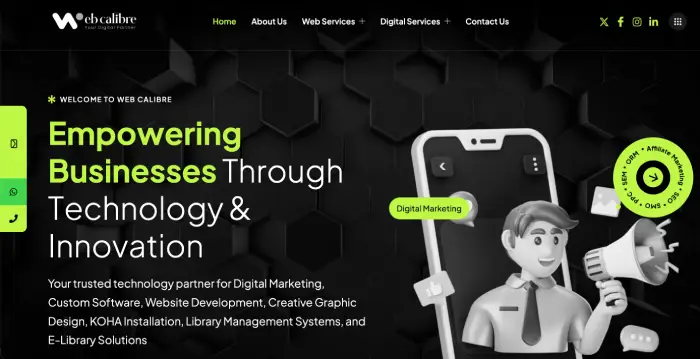
Web Calibre is a Delhi-based digital services company whose core business sits in website design, SEO, SMO, and PPC, and which has built a dedicated library software vertical alongside its wider client work in branding and web development. Rather than writing a library management system from the ground up, Web Calibre’s approach in this space is closer to that of a consultant and implementation partner — it publishes detailed, comparison-style research on Indian library software (its own guide comparing Koha, eGranthalaya, Libsys, SOUL, NewGenLib, SLIM21, Destiny, OpenBiblio, Evergreen, and Alice runs to several thousand words) and offers to handle installation, quoting, and support for institutions that want a library system set up without doing that homework themselves. This positioning is useful for a specific kind of buyer: a librarian or administrator who does not yet know which underlying software fits their institution and would rather work with a local Delhi-NCR team through the decision than pick a product cold off a vendor’s marketing page.
The company operates from three addresses across Delhi and Lucknow, which points to a reasonably established regional presence rather than a single-person operation, and it maintains active social channels (X, Facebook, Instagram, LinkedIn) alongside a WhatsApp-first contact line — a detail that matters in India, where institutional buyers often prefer a quick WhatsApp message over filling out a contact form. Because its parent business is digital marketing, one practical strength worth noting is that Web Calibre-built library portals and OPAC front-ends tend to come with more attention to how the public-facing search page looks and performs than a pure back-end automation vendor might invest — useful for institutions that also want their library’s web presence to look current.
What buyers should verify directly: since Web Calibre is not the original developer of the underlying library engines it deploys (typically open-source systems like Koha), long-term data ownership, export rights, and what happens to support if the relationship ends should be confirmed in writing before signing, exactly as with any implementation partner working on top of open-source software.
Rating & Expert Review
Web Calibre does not carry a large public review footprint specific to library automation the way a mainstream SaaS product might on G2 or Capterra — its reputation is built more through published research content, its social presence, and direct referrals. For an institution evaluating it, treat this as an implementation partner: the value is largely in the pre-sales research and post-installation support relationship rather than a packaged, reviewed product.
Pricing & Services
Web Calibre quotes on a project basis through a request-a-quote form rather than publishing fixed prices — standard practice across this entire vendor category in India. Services span library software installation, ongoing management, staff training, technical support, and data migration, layered on top of its broader web design, CMS, and digital marketing offerings.
Customer Feedback
Detailed public testimonials specific to the library vertical were not found independently; feedback on the company’s wider digital services is visible across its social channels. Institutions considering Web Calibre for library work should ask for library-specific client references separately from its general marketing client list.
2. E-LibSol (eLibSol India)
Address: 181A, Jammu Mohalla Street, Maujpur, Shahdara, Delhi – 110053
Phone: +91-7217707343 / +91-11-49054828
Email: info@elibsol.com
Website: elibsol.com
Overview
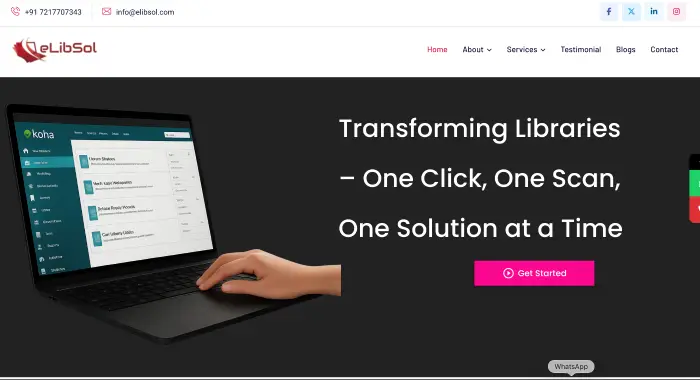
eLibSol is one of the more specialised names on this list — its entire business is library automation, and it says so plainly: over 150 libraries automated and more than 15 years of experience specifically in Koha, DSpace, RFID, and related open-source library systems. Where a lot of vendors in this space treat library software as one line item among many, eLibSol has built its case studies, its team structure, and its service catalogue entirely around it. Its published case work includes a migration from LibSys to Koha ILS at Aligarh Muslim University’s library, a DSpace-based digital repository set up for VIPS (Delhi), an RFID-and-Koha integration project at Chandigarh University’s Lucknow campus, and a website rebuild for Jagmohan College of Law — a spread that covers migration, repository, hardware integration, and web presence work rather than just one type of project.
The company’s stated specialisation is squarely in open-source library technology: Koha installation, support, and AMC (offered not just across India but extended into Nepal and Bhutan, according to its own service pages); DSpace installation for institutional repositories; RFID solutions for asset and library management; library data migration; and automation training. It has also picked up recognition from Maulana Azad Library at AMU, the Sikkim Academy Library (via the state’s Cultural Minister), and an appreciation certificate from Jamia Hamdard University Library, which — while not independent third-party ratings — are at least verifiable institutional acknowledgements rather than marketing copy alone. eLibSol lists a small, named technical team (an IT head and a technical head specifically credited for library automation), which is a reasonable signal for a mid-sized specialist firm.
Worth flagging: eLibSol operates as a brand under the same corporate group as LogiXense Solutions (see #3 below) and shares a support phone number with it, so buyers dealing with either brand are effectively dealing with the same underlying team.
Rating & Expert Review
eLibSol’s own site claims 120 happy clients and around 300 finished projects, alongside its 150+ libraries automated figure — these are self-reported numbers, not third-party audited ones, but the case studies backing them name specific real institutions (AMU, VIPS, Chandigarh University), which is more verifiable than a generic client counter. Its Facebook page shows a genuine, sustained following (over 5,500 likes) built up over years rather than a recently inflated number, which is a soft but real signal of an established, ongoing operation.
Pricing & Services
Like nearly every vendor in this category, pricing is quote-based and depends on scope. Core services: Koha installation/support/AMC, DSpace installation, RFID solutions, library data migration, automation training, and library website design and development.
Customer Feedback
The company’s published FAQ section directly addresses common buyer concerns — migration safety, training inclusion, ongoing support channels (phone, email, WhatsApp), and customisation — which suggests these are the actual questions institutions have been asking it over time, rather than generic marketing FAQs.
3. LogiXense Solutions
Address: 555, 2nd Floor, Site 1, Metro Pillar No. 625, Vikaspuri Mor (Janakpuri), Delhi – 110018
Phone: +91-9911556629 / +91-11-49054828
Email: info@logixense.com
Website: logixense.com
Overview
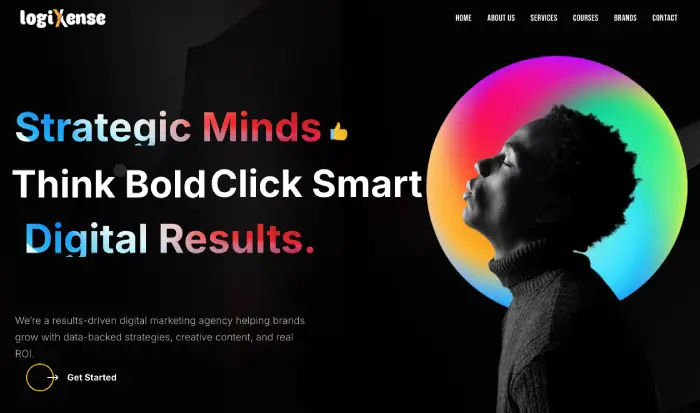
LogiXense Solutions is honestly best described, by its own website, as a Delhi-based digital marketing, web design, and development agency — SEO, social media, paid advertising, content marketing, and app development are its headline services. It earns its place in a library automation shortlist for a different reason: it is the parent group behind eLibSol, one of the more specialised library automation brands covered above, and it lists eLibSol openly under “Brands We Own” on its own homepage. In practice, this means an institution approaching LogiXense for library work is being routed toward the same team and infrastructure that runs eLibSol, while an institution approaching it for a library website redesign, SEO for a library’s public catalogue pages, or app development for a library’s mobile OPAC is dealing with LogiXense’s core marketing and development strength directly.
This dual identity is worth being transparent about rather than glossing over, because it changes what you should actually ask for. If the requirement is core ILS work — cataloguing, circulation, RFID, DSpace — the conversation should default to the eLibSol side of the group, which has the dedicated 15-year track record in that specific domain. If the requirement is a library’s digital presence — a modern, mobile-friendly library website, better search visibility for an OPAC, a promotional campaign around a new digital library launch, or a library mobile app — LogiXense’s own specialism in digital marketing and app development is the more directly relevant strength. Institutions already running Koha or another ILS but wanting a better public-facing website around it are a natural fit for this combination.
Founded in 2021 according to its own site copy, LogiXense is a comparatively newer entity than eLibSol, though it operates from the same Delhi business cluster and shares leadership and contact infrastructure with the older, library-focused brand.
Rating & Expert Review
LogiXense’s site features a set of named client testimonials focused on its digital marketing and web development work, describing responsiveness and design quality — genuine-reading feedback, though presented on the company’s own site rather than an independent review platform, so it should be read as self-published rather than third-party verified.
Pricing & Services
Quote-based, project-scoped. Core services: digital marketing (SEO, SMO, paid advertising, content and email marketing), web design and development, app development, and — through its ownership of eLibSol — library automation, Koha/DSpace installation, and RFID solutions.
Customer Feedback
Reviews visible on the company’s site are for its marketing and web work specifically; buyers evaluating it for library automation should request eLibSol’s dedicated library case studies rather than relying on LogiXense’s general client list alone.
4. LIBSYS Ltd
Address: 631–633, Udyog Vihar, Phase V, Gurugram – 122016, Haryana (regional offices in Kolkata and Bangalore)
Phone: +91-124-4894100
Email: info@libsys.co.in (support: support@libsys.co.in)
Website: libsys.co.in
Overview
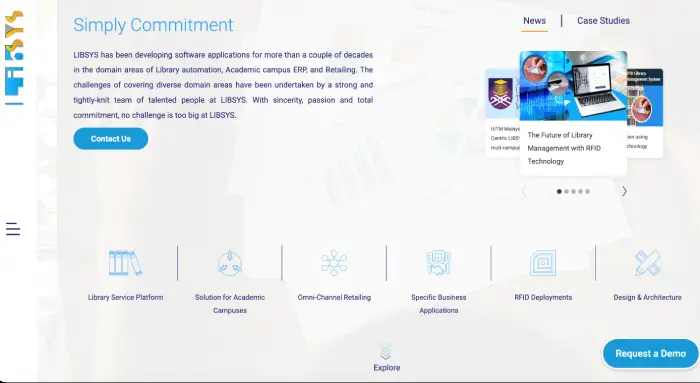
LIBSYS is, by a fair margin, the oldest and most established name on this list — a Delhi-NCR software company that has been building library automation products since 1984, according to its own LinkedIn profile, making it older than most of the open-source alternatives it now competes against. It is a proprietary, paid system, and that is central to its pitch: rather than assembling a stack of open-source tools, LIBSYS builds and owns its own product line — LIBSYS 10 as the core library management and automation platform, LSEase as a lighter offering for smaller libraries, and LSmart as its dedicated RFID security and self-service system, alongside adjacent academic-ERP and retail products that share its underlying technology.
This is the vendor most likely to come up when a large university, a research institute, or a corporate library needs a single accountable vendor with a full support organisation behind it, rather than a community-supported open-source deployment. Its own material lists cataloguing to international MARC21 standards, circulation with configurable fine rules, acquisitions and vendor/budget tracking, serials control, discovery-layer OPAC, cloud and mobile access, role-based security, and API-level integration with institutional authentication systems like LDAP — a genuinely enterprise-grade feature list, which is reflected in its positioning toward larger institutions rather than small school libraries.
The trade-off, openly acknowledged even in comparison content published by other vendors on this list, is cost and flexibility: a proprietary, decades-old commercial product like LIBSYS carries licensing and AMC costs that a Koha-based deployment does not, and customisation generally has to go through the vendor rather than being done in-house. For an institution with a stable, well-funded IT budget and low appetite for managing an open-source stack itself, that trade-off is often the right one; for a cash-constrained small library, it usually is not.
Rating & Expert Review
LIBSYS is widely referenced across Indian library-science teaching material and comparison guides as one of the standard proprietary options taught alongside SOUL and Koha, which reflects genuine, long-running market presence rather than recent marketing push. It does not appear to carry a large public star-rating footprint on consumer review platforms — typical for enterprise B2B software sold through direct sales rather than self-serve signup — so institutional buyers should ask LIBSYS directly for references among peer institutions of similar size.
Pricing & Services
Quote-based and scoped to number of users, modules, and deployment type (cloud vs on-premise). Core products: LIBSYS 10 (full ILS), LSEase (small-library edition), LSmart (RFID), plus academic ERP and retail-automation lines under the same company.
Customer Feedback
Independent, dated customer reviews were not found in public search results at the time of this research — a gap that is common for long-established enterprise vendors whose customer relationships are managed directly rather than through review platforms. Prospective buyers should request current reference sites directly from LIBSYS.
5. Verus Solutions Pvt Ltd (NewGenLib)
Address: Flat 101, Swarna Bharathi Towers, A.S. Raju Nagar, Opposite J.P.N Nagar Colony, Miyapur, Cyberabad, Hyderabad – 500049, Telangana
Website: verussolutions.biz
Overview
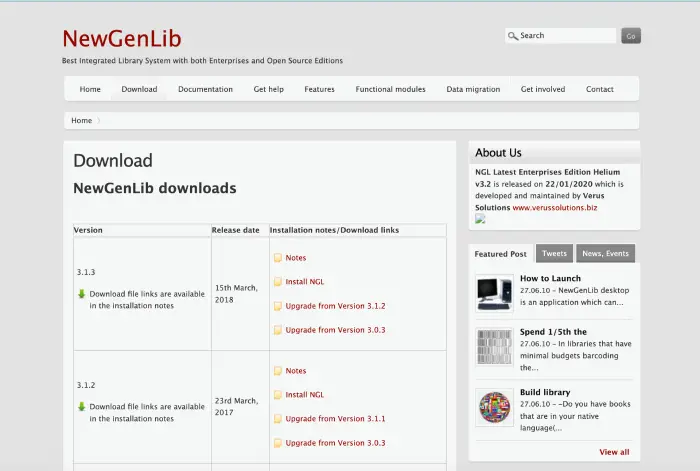
Verus Solutions is the technical developer behind NewGenLib, one of India’s most internationally adopted open-source library systems, first released in 2005 and declared fully free and open-source under the GNU GPL license in January 2008. The system was built with domain guidance from the Kesavan Institute of Information and Knowledge Management (KIIKM), a Hyderabad-based non-profit focused specifically on library and knowledge-management research, while Verus Solutions has handled the actual software engineering. According to public documentation, NewGenLib has been installed in more than 2,500 libraries across 58 countries — a genuinely global open-source footprint that few Indian-origin library systems can claim.
Technically, NewGenLib is built on well-tested open components (PostgreSQL, Apache Tomcat, Solr/Lucene), is fully Java-based and platform-neutral, and complies with the standard international interoperability protocols — MARC21, MARC-XML, Z39.50, SRU/W, and OAI-PMH — which matters for any library planning to eventually share catalogue data with other institutions or national repositories like the National Digital Library. Its Unicode 4.0 compliance and internationalisation support have made it a genuine choice for multilingual Indian cataloguing, not just an English-only system with token language support bolted on.
Verus Solutions’ own commercial offering sits around this open-source core: application setup, data migration, customisation, staff training, and ongoing support, offered as both an Open Source Edition and an Enterprise Edition of NewGenLib. This is a common and sensible model in the open-source library world — the software is free, but the expertise to deploy and support it reliably is what libraries actually pay Verus Solutions for.
Rating & Expert Review
NewGenLib is documented and cited in academic library-science literature (including peer-reviewed papers on NewGenLib as an open-source library automation solution), which is a stronger form of third-party validation than typical consumer reviews. Its global installation count (2,500+ libraries, 58 countries) is independently referenced in library technology guides rather than being solely a company claim.
Pricing & Services
NewGenLib’s Open Source Edition licence is free; Verus Solutions charges for implementation, data migration, customisation, training, and support — plus a separately licensed Enterprise Edition for institutions wanting a commercially supported build.
Customer Feedback
Feedback is largely embedded in academic and library-community discussion forums around NewGenLib rather than a commercial review platform, consistent with its identity as a community-adopted open-source system with a small commercial development team behind it.
6. Algorhythms Consultants Pvt Ltd (SLIM / iSLIM)
Address: Head office in Pune, Maharashtra
Website: slimkm.com
Overview
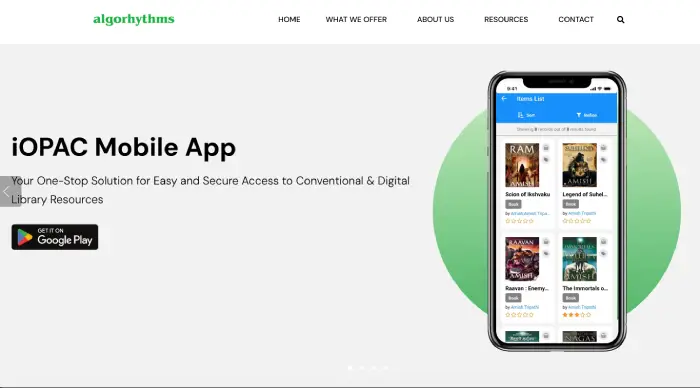
Algorhythms Consultants is the Pune-based company behind SLIM (and its web/cloud successor, iSLIM) — describing itself as a long-serving technology provider for library and archives automation in India and abroad. What stands out about this vendor compared to several others on this list is the range and specificity of its named client references: testimonials cite Infosys Limited’s Knowledge Resource Centre in Pune, Mahindra Research Valley, Pragati College of Arts & Commerce (Mumbai), the Willingdon Sports Club’s library, and PlaySmart, a toy-lending library in South Mumbai. That spread — a large IT corporation, an R&D centre, an academic college, a private members’ club, and a toy library — suggests the product genuinely flexes across very different types of collections rather than being purpose-built for one sector alone.
iSLIM is offered in both on-premise and cloud-based versions, structured around modular acquisition, cataloguing, circulation, and serials functions, and the company markets a set of “Advanced Modules” for RFID-based self-checkout and reduced wait times at busy circulation desks. A published feature emphasis on GDPR-style, privacy-conscious member de-registration (automatic end-date handling and data removal) is a slightly unusual point of focus for an Indian library vendor and suggests some international client exposure shaping its product decisions, consistent with archival and institutional clients beyond India mentioned in its own case studies (including a remote institute working in Tibetan/Bhoti-language materials).
Independent software-review sites list iSLIM’s direct competitors as LibrarySoft and Evolve Library, placing it in the mid-market of Indian library software rather than at the enterprise end occupied by LIBSYS, or the community-supported end occupied by Koha and NewGenLib.
Rating & Expert Review
On SoftwareSuggest, a third-party Indian software review platform, user feedback for iSLIM is consistently positive on ease of use, feature completeness (from basic to advanced modules), WebOPAC quality, and after-sales support, with the most common caveat being that pricing runs a little higher than some alternatives — a genuinely useful, independently sourced counterpoint rather than only self-published testimonials.
Pricing & Services
Quote-based, offered as subscription (cloud) or licensed (on-premise) editions. Reviewers on independent platforms note pricing sits at the higher end for the category, generally in exchange for a more complete out-of-the-box module set and support quality.
Customer Feedback
Named client testimonials span corporate knowledge centres, colleges, private clubs, and niche archival collections — a genuinely diverse reference base for a mid-sized vendor, backed by both self-published case studies and independent review-platform ratings.
7. LIBSOFT Solutions
Address: Zion Tower, Ulloor–Akkulam Road, Medical College PO, Thiruvananthapuram – 695011, Kerala
Phone: +91-9447272199 / +91-9061484198
Email: mail@libsoft.org (support: support@libsoft.org)
Website: libsoft.org
Overview
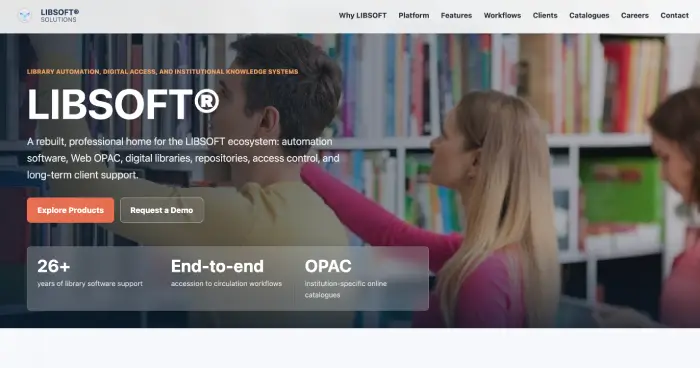
LIBSOFT is a Kerala-headquartered library automation specialist that describes itself as having supported clients for over 26 years — a genuinely long run for a regional vendor, and one that shows in the breadth of institution types it lists: engineering colleges, medical colleges, arts and science colleges, institutions of physical education, departments of the University of Kerala and University of Calicut, special and theological libraries, Kendriya Vidyalaya libraries, and school libraries. Its product suite covers the core automation package (accession, classification, cataloguing, membership, circulation, barcode/RFID, and search), a separate Digital Library layer for archival, rare, and multimedia material, a hosted Web OPAC service, a Gate Register module for tracking member entry and exit via barcoded ID cards, an Institutional Repository product, and a Virtual Library offering for remote digital access.
What is unusual and worth noting honestly is that LIBSOFT’s own site describes itself explicitly as faith-guided, citing Joshua 1:5-9 as part of its stated organisational identity. This is not a technical differentiator, but it does shape the tone of the company — it emphasises long-term client relationships, patient professional support, and steady operational confidence over aggressive sales positioning, and its client base (which includes theological institutions specifically) reflects that orientation. For institutions in Kerala and South India that value a stable, regionally rooted long-term vendor relationship over a large national brand, this is a genuinely relevant factor rather than incidental detail.
LIBSOFT also runs a structured hiring pipeline for software trainees and developers (Python/Django, Java/Spring, mobile, PHP/Laravel) directly from its own site, suggesting an actively growing in-house technical team rather than a purely reseller-style operation.
Rating & Expert Review
LIBSOFT does not appear to carry a large presence on national review aggregators, consistent with its identity as a regionally focused, long-tenure Kerala vendor working mostly through direct institutional relationships rather than national marketing. Its 26-year operating history and the sheer range of institution types listed as clients (spanning both Kerala and Calicut university departments) function as its strongest available credibility signal.
Pricing & Services
Quote-based; the company markets itself on “reduced rate implementation” for budget-conscious institutions alongside its full-featured platform. Services: core library automation, digital library, Web OPAC, gate register, institutional repositories, RFID, and smart-card solutions.
Customer Feedback
No independently dated review-platform ratings were found; client credibility rests on its long-standing, named institutional relationships across Kerala’s academic and religious institutions rather than a public review count.
8. Hembro Infotech Pvt Ltd (LibNet)
Address: Sreenagar Lane 4, Milanchakra, Near TV Tower, DIG Office, Agartala – 799003, Tripura
Website: hembroinfotech.com
Overview
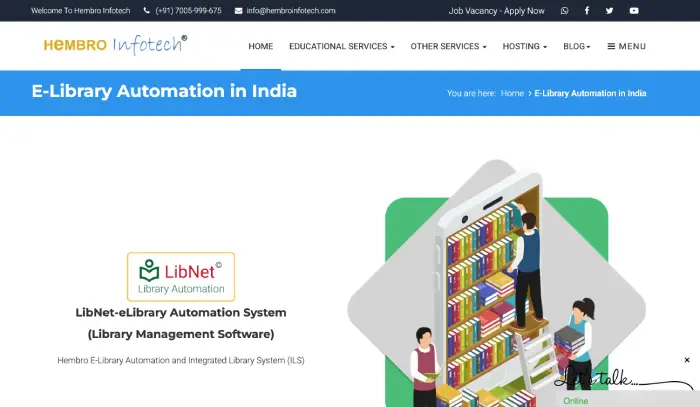
Hembro Infotech is a North-East India-headquartered IT company, founded in Agartala, Tripura, in 2014 by Kiran Kumar Hembrom and Mausumi Debnath, though it had operated informally as a proprietorship since 2010. Its library automation product, LibNet, is one part of a broader school- and campus-management software portfolio that also includes online admission portals, online examination systems, an e-learning platform, payment gateways, and bulk-SMS services — meaning most of Hembro’s clients likely first come to it for wider institutional digitisation and then adopt LibNet as one module of a larger system, rather than approaching it purely as a library specialist the way LIBSOFT or eLibSol are.
LibNet itself is described as a complete web-based library management and automation system with an eLibrary mobile app and multi-location support, letting librarians track issued, returned, and newly added books, with Dewey Decimal Classification support and a Web OPAC for public search. Its own material states LibNet was built to align with NAAC’s “Quality Indicators in Library and Information Services” guidelines — directly relevant for the many Indian colleges whose main motivation for automating is accreditation. LibNet supports both bar-code and RFID circulation.
Hembro Infotech’s reach is genuinely national on paper — its service pages list availability across a very long roster of Indian cities and states, from Agartala itself to Delhi, Mumbai, Bengaluru, and dozens of Tier-2 towns — though this kind of broad city listing on a services page is standard SEO practice across small Indian software firms and should be read as “we can serve you remotely,” not as a claim of physical branch offices everywhere listed.
Rating & Expert Review
As a smaller regional company (reported team size in the range of 6–50 employees across its group entities in third-party business databases), Hembro Infotech does not carry a large public review footprint specifically for LibNet. Its credibility rests more on its decade-plus operating history from Tripura and its broader school-software portfolio than on independently verified library-specific ratings.
Pricing & Services
Quote-based. LibNet is typically positioned as one module within Hembro’s wider institutional software suite (admissions, exams, e-learning, payments), rather than sold purely as a standalone library system.
Customer Feedback
Detailed, dated public reviews specific to LibNet were not found independently; buyers should request library-specific references separately from Hembro’s broader school-software client list, since the two customer bases likely overlap only partially.
9. Codeachi Technologies Pvt Ltd
Address: 1st Floor, Webel IT Park, Satellite Township, Kalyanpur, Asansol – 713302, West Bengal
Website: via IndiaMART storefront
Overview
Codeachi Technologies, set up in 2015 and based in Asansol, West Bengal, occupies a genuinely different niche from every other vendor on this list — it sells the CodeAchi Library Management System as a comparatively low-cost, downloadable, desktop-first product (Windows 7 and above), aimed squarely at smaller school and college libraries rather than large multi-branch institutions. Rather than a quote-only cloud/enterprise sale, its listed pricing on IndiaMART starts around ₹14,999 per licence for its standard package, with a free version supporting collections of up to 1,000 books — an unusually transparent, published entry price point in a category where most vendors refuse to state numbers publicly.
Feature-wise, CodeAchi covers the fundamentals a small library actually needs: adding and managing member records for students and staff, category-based book organisation with custom lending periods and fine rates per category, a location-tracker feature to note the physical rack/shelf number of each book (a genuinely practical touch for a small library where “the catalogue says it exists but nobody can find it on the shelf” is a common real problem), automatic fine calculation for overdue returns, and over 50 report templates. Support is offered as 24×7 chat, alongside user guides, video training, and installation help on request.
This is not the vendor for a university running RFID self-checkout across five campuses. It is a genuinely sensible option for a school, a small college department library, or a coaching-institute library that needs to move off paper registers without committing a large annual budget or a multi-month implementation project — the trade-off being a desktop-bound, Windows-only tool rather than a cloud-hosted, mobile-accessible system.
Rating & Expert Review
Codeachi’s public presence is largely through IndiaMART and Justdial listings rather than independent software-review platforms, typical of small-ticket desktop software sold to price-sensitive small institutions. Its GST registration (dated 2017) and consistent business listing across multiple directories over several years point to a genuinely operating small firm rather than a fly-by-night listing.
Pricing & Services
One of the few vendors on this list with a published starting price — around ₹14,999 for its standard Windows-based library management licence, with a free tier for very small collections (under 1,000 books). This is a one-time licence model rather than a recurring cloud subscription.
Customer Feedback
Detailed named case studies were not found; feedback is limited to marketplace-style listings rather than a dedicated review platform, consistent with a small, marketplace-distributed desktop product.
10. Easylib Software Pvt Ltd
Address: 1147/B, 18th B Main Road, Rajaji Nagar 5th Block, Bengaluru – 560010, Karnataka
Website: easylib.net
Overview
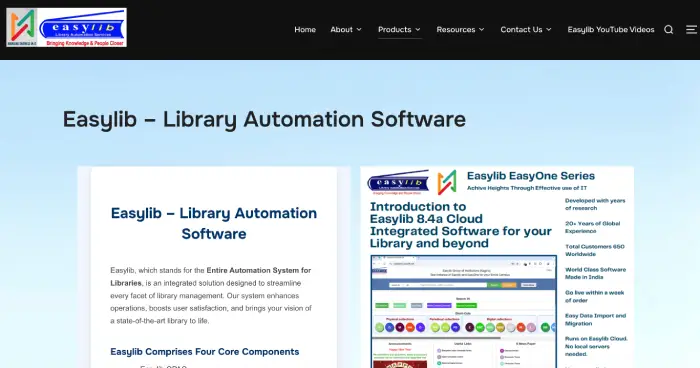
Easylib is a Bengaluru-based software company, incorporated in 1998, that has spent over 25 years working specifically with educational institutions on library and campus administration software. Its flagship library product, EasyLib — “Entire Automation System for your Libraries” — bundles cataloguing (MARC21-compatible, RDA-compliant), circulation, periodicals management, a digital library layer built on Dublin Core metadata standards, visitor tracking, membership management, ID cards, and barcode support into one platform, with a companion student-facing OPAC and a separately upgraded Web-based E-PAC (Web OPAC) that runs across intranet and internet without needing client-side installation.
What differentiates Easylib from most pure library vendors on this list is its parallel product, EasyOne, a broader campus-and-institution management platform covering admissions, academic administration, student master data, communication, research management, placements, and asset management for buildings, computers, furniture, and lab equipment — with the library module (EasyLib) as one integrated component of that wider system, similar in structure to Hembro Infotech’s approach but built for a different institutional tier (colleges and universities rather than schools). This makes Easylib a natural fit for institutions that want their library system to eventually plug into a single campus-wide administrative platform rather than remain an isolated tool.
The company describes following an “Agile Continuous Improvement” release process, adding features roughly every fifteen days, and runs regular live webinars for existing clients on specific modules (its own public schedule has covered periodicals-subscription management, for instance) — a practical, ongoing-training approach that is relatively uncommon among the smaller vendors on this list and suggests a genuinely active support relationship rather than a one-time installation-and-forget model.
Rating & Expert Review
Easylib’s LinkedIn presence and long, continuous operating history (since 1998) support its claim of sustained relevance in the Indian educational-software market, though — as with most B2B vendors in this category — it does not carry large public star-rating volumes on consumer review platforms. Marketplace listings for its library automation product show pricing quoted around ₹1,75,000 for one indicative package on IndiaMART, giving buyers at least a rough anchor point, though actual project pricing will vary by scope.
Pricing & Services
Quote-based for full deployments; one indicative marketplace listing shows a starting price around ₹1,75,000 for its library automation package, which sits meaningfully above Codeachi’s small-library pricing and reflects Easylib’s positioning toward colleges and universities rather than very small libraries.
Customer Feedback
Feedback is visible mainly through the company’s own webinar activity and LinkedIn updates rather than an independent review platform; its 25+ year operating history in a competitive Bengaluru software market is itself a reasonable indirect signal of sustained client retention.
Library Automation: How Much Does It Cost in India in 2026?
Library automation costs vary widely because every library has different collection sizes, workflows and technical requirements.
A small school library may need only basic software and barcodes. A university may require data migration, Koha configuration, cloud hosting, RFID, DSpace, training and annual support.
Approximate planning ranges for 2026 are:
| Library requirement | Indicative cost range |
|---|---|
| Basic school library software | ₹15,000–₹60,000 |
| Small library automation with barcode | ₹40,000–₹1.5 lakh |
| College library implementation | ₹1 lakh–₹4 lakh |
| University-level automation | ₹3 lakh–₹12 lakh or more |
| RFID automation | ₹5 lakh–₹30 lakh or more |
| Large multi-branch project | Custom quotation |
These are planning estimates, not standard market prices. Actual costs depend on collection size, data quality, hardware, software, hosting, migration, training and support.
Main Cost Factors
Software or subscription: Some systems charge a one-time licence; others charge annually or monthly.
Data migration: Old records may need cleaning, conversion and verification.
Barcode equipment: Barcode printers, scanners and labels add to the budget.
RFID hardware: Tags, readers, security gates, self-check machines and installation can significantly increase cost.
Hosting: Cloud hosting may involve recurring fees.
Training: Staff training should be included in the project budget.
Annual maintenance: Support, updates, backups and troubleshooting may be charged separately.
Strong procurement advice
Do not compare only the first-year quotation.
Ask for the five-year total cost of ownership, including:
- Implementation
- Migration
- Hardware
- Hosting
- Training
- Annual support
- Upgrades
- Customisation
- Exit or data-export charges
A low initial quotation can become expensive if support, migration or upgrades are excluded.
Frequently Asked Questions
1. Which is the best library automation provider in India?
There is no single best provider for every library. Web Calibre may be useful for learning and practical library technology guidance, E-LibSol has strong visibility in Koha, DSpace and RFID services, while other providers may be better suited to enterprise or academic requirements. The correct choice depends on collection size, budget, software preference and support needs.
2. Is Koha free for Indian libraries?
Koha is open-source software, so there is generally no traditional licence fee. However, implementation, hosting, migration, customisation, training and support may involve costs.
3. How long does library automation take?
A small library may complete implementation in a few weeks. A large college or university project can take several months, especially when records require cleaning and migration. RFID projects may take longer because every item must be tagged and tested.
4. Is barcode or RFID better for a library?
Barcode is generally more affordable and suitable for many small and medium libraries. RFID can support faster transactions, self-service and security, but it requires higher investment. RFID should be selected when the library’s collection size and workflow justify the cost.
5. What should a library check before selecting a provider?
The library should check data migration, software standards, training, support response time, backup policy, data ownership, export options, hosting, security, upgrade costs and total five-year cost. A live demonstration using actual library records is strongly recommended.
Final View
Library automation is not a software purchase. It is a long-term information-management project.
The best system is not necessarily the one with the most features. It is the one that matches the library’s real workflow, protects its data, supports staff and remains usable after the implementation team leaves.
For Indian libraries in 2026, the most important selection criteria are:
- Data quality and migration capability
- Library-domain expertise
- Staff training
- Reliable support
- Open data export
- Long-term cost
- Standards compatibility
- Clear implementation responsibility
A library should select technology that improves access to knowledge—not technology that creates another system for staff to manage.
Editorial disclosure: This article is an independent research-based comparison. Rankings are editorial and may change as providers update their products and services. Contact details, pricing, features and service availability should be verified directly before making a purchase decision.